
Create and run a MIPS project
Create a MIPS project, build and run it, inspect registers, use breakpoints and Undo, and share the project.
Create a MIPS project, run an addition program, inspect its registers, and use Step, Undo, and a breakpoint. You need a browser; no previous MIPS knowledge is required.
Create your first project
Open Create new project. Give the project a name such as My first calculation, choose MIPS under Language, then choose Create. The project opens in the editor, also called the Workbench.
Replace the assembly file's starting text with the program below. Alternatively, try the embedded example and choose Open in editor to open it as a project. Use the full editor for the remaining steps.
.text
.globl main
main:
li $t0, 17
li $t1, 25
add $t2, $t0, $t1
li $v0, 1
move $a0, $t2
syscall
li $v0, 11
li $a0, '\n'
syscall
li $v0, 10
syscallli, add, move, and syscall are instructions. .text and .globl main tell the assembler how to organize the program; main: names its starting location. Step does not execute those setup lines.
The first two li instructions put 17 in $t0 and 25 in $t1. add puts their sum in $t2. A register is a small storage location in the simulated processor.
Each syscall requests the service selected in $v0, with an input in $a0 when needed. Service 1 prints the sum, service 11 prints the newline, and service 10 ends the program. Keep this section unchanged during the tour.
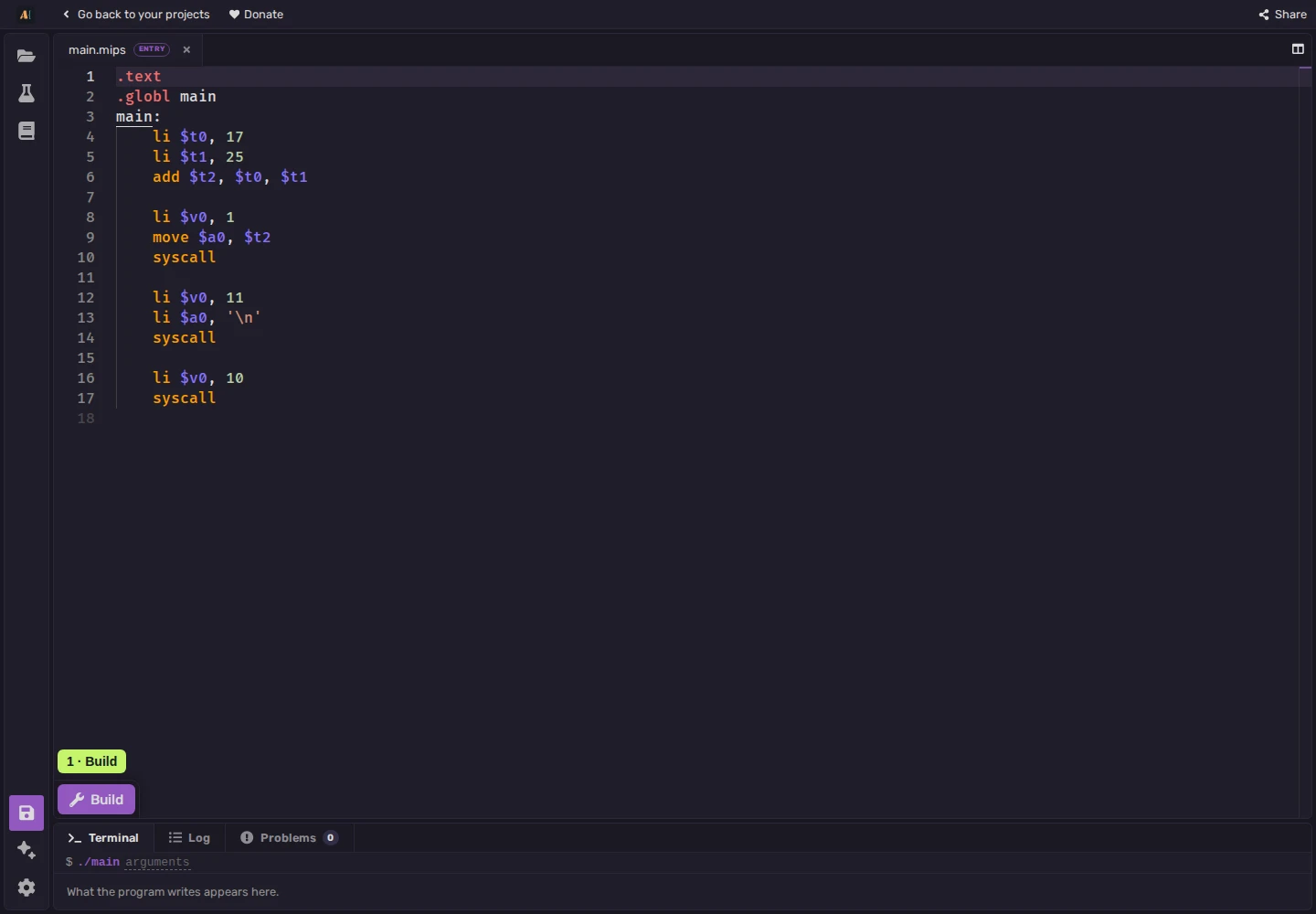
Build, then run
Choose Build beneath the code. It translates the assembly into executable instructions and prepares the simulator; the calculation has not run yet.
Choose Run, then open Terminal below the code if needed. The output is:
42
Find $t2 in Registers. It holds 42, which may appear as hexadecimal 0000002A. Hover over the value to inspect its numeric representations.
If Build fails, open Problems and select a message to reach its source line. Check the language and copied program, including the $ characters. Choose Stop to return to editing, then Build after any change.
Step through the calculation
Choose Stop, then Build to reset execution. Choose Step three times:
$t0receives 17.$t1receives 25.$t2receives their sum, 42.
While the program is paused with instructions left, the highlight marks the next instruction. Registers show the result of the previous step. Step executes one machine instruction; an assembly form that expands into several instructions can take several clicks.
After the addition, choose Undo beside Run and Step. It restores the state before that instruction. Step again to repeat the addition. Execution Undo uses a finite history and is separate from undoing text edits.
Set a breakpoint
A breakpoint pauses Run before an instruction. Choose Stop, then click the margin to the left of this line:
add $t2, $t0, $t1When the marker appears, Build and Run. Execution pauses before the addition, with 17 in $t0 and 25 in $t1. Step performs the addition; Run continues to the end. Click the marker to remove it.
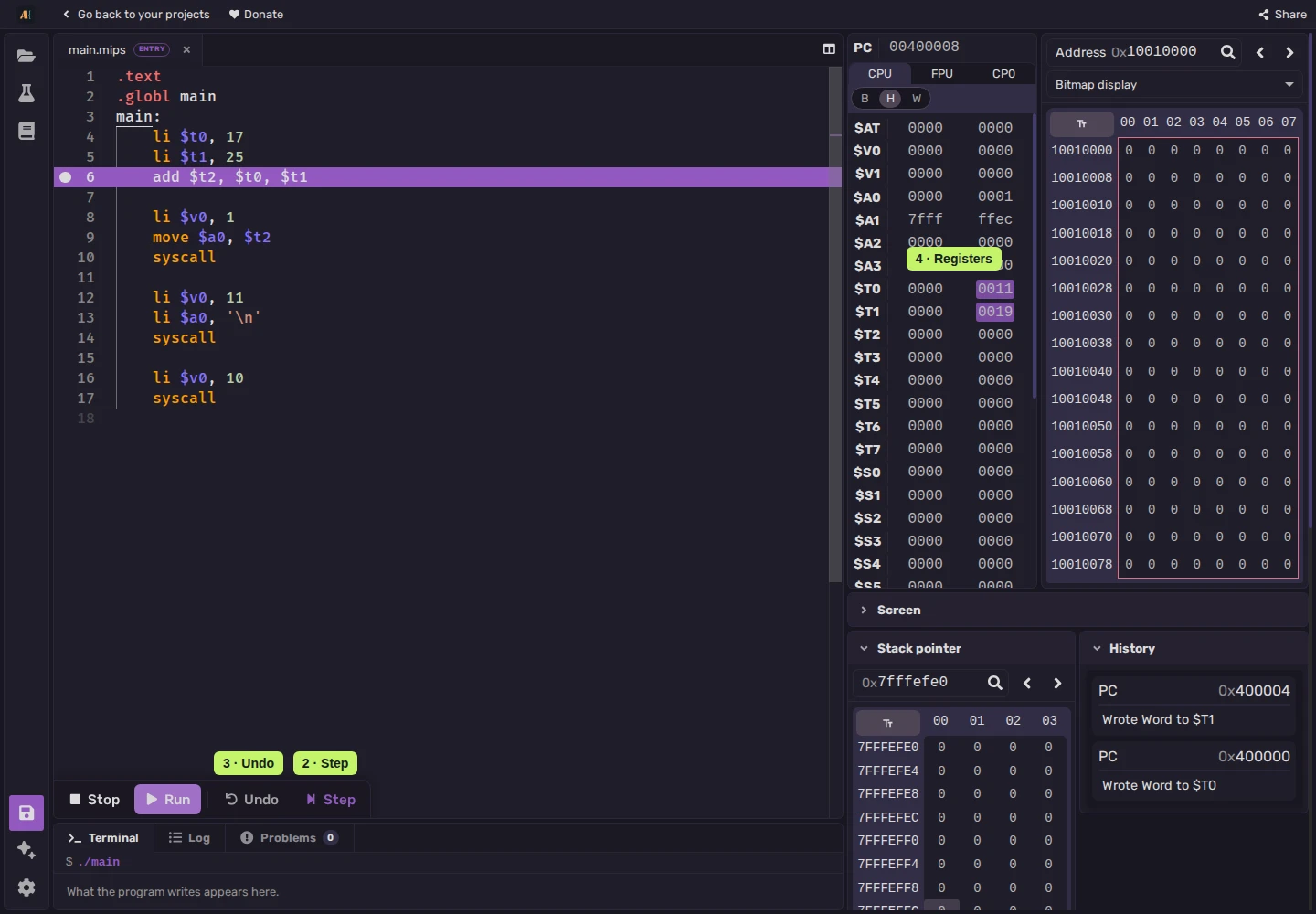
In the screenshot, hexadecimal 0011 and 0019 mean decimal 17 and 25.
For another run, choose Stop, change 25 to 8, then Build and Run. Compare $t2 and Terminal with the sum you expect.
Share the project
Return to Projects, find the project, and choose Share this project. This copies a link to your clipboard. The link contains a snapshot of the project; create a new link to share later changes.
The MIPS course covers the language. The MIPS browser guide adds keyboard input and a breakpoint after reading it.